
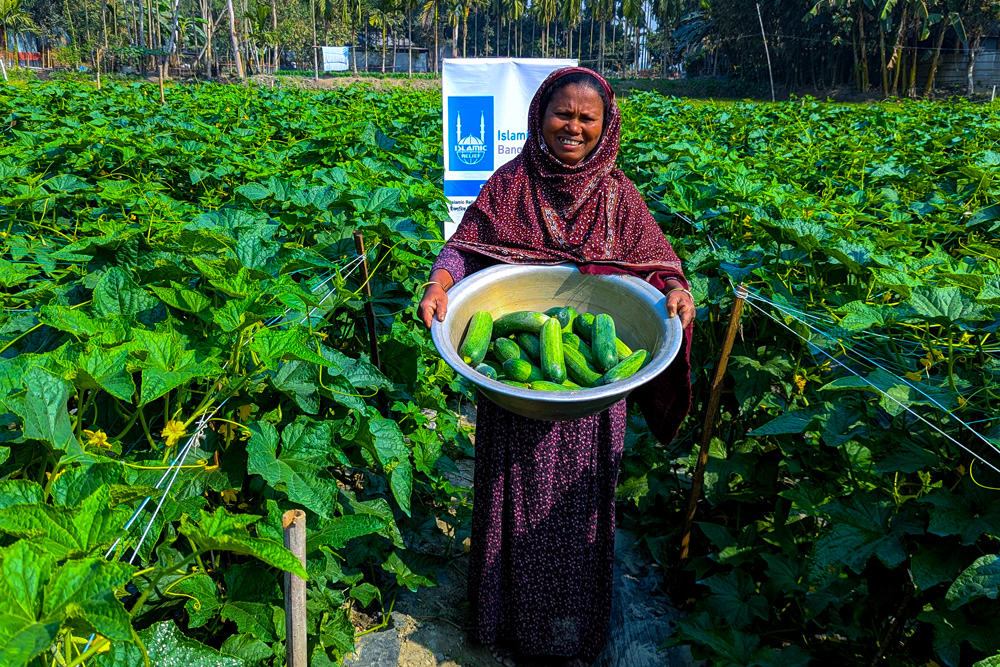
When the Teesta River washed away her family’s land, crops and livestock, Rupia Begum had to start again.
The family rebuilt their home on just two decimals of land on the riverbank. Her husband relied on daily labour, and they had two daughters to support. Rupia had few chances to earn an income of her own.
But she was determined to build a different future.
With support from Islamic Relief’s SEED project, Rupia joined the Dokkhin Nodirpar Women Entrepreneurs Group in Kaunia Upazila, Rangpur, taking an important step towards building her livelihood. A start-up grant of BDT 25,000 helped her take the first step. She spent BDT 20,000 on three goats and the remaining BDT 5,000 on a raised goat shed, feed and vaccinations.
The grant gave Rupia a starting point. What changed her livelihood was how she used it.
From livestock to climate-smart farming
At weekly group meetings, Rupia learned that farmers could get advice and services locally from the Sub-Assistant Agriculture Officer and the Department of Agricultural Extension.
She acted on it.
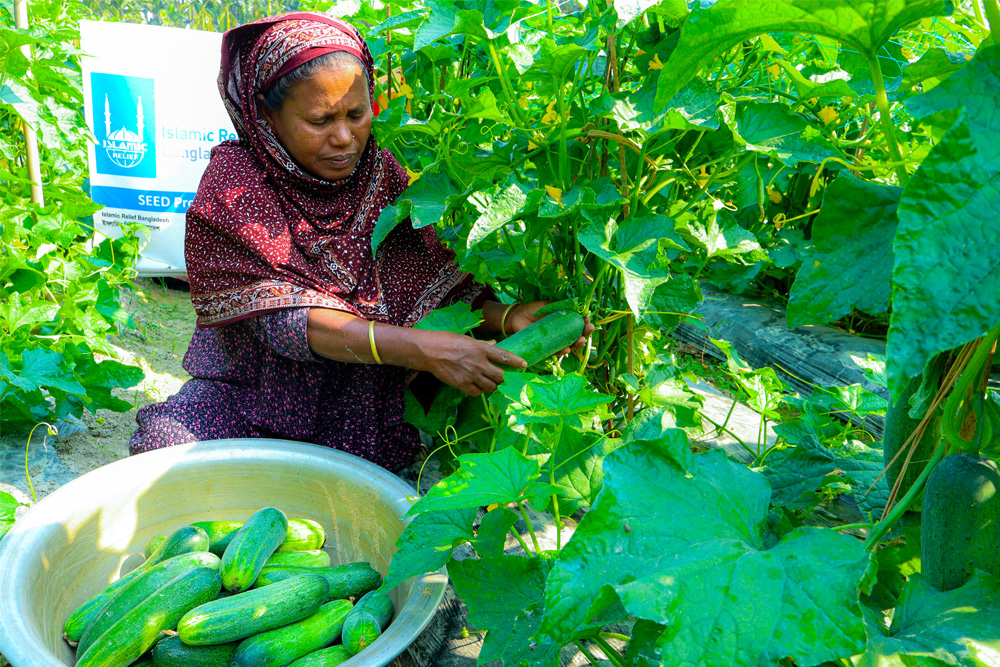
Rupia sold two goats for BDT 18,000, leased 25 decimals of land for six months and began growing cucumbers. With guidance from the local agriculture officer, she used improved techniques such as mulching, better crop management, cross-pollination and pheromone traps to control fruit flies.
The Department of Agricultural Extension provided technical support and farming inputs. Rupia paid for irrigation, trellising and other production costs herself. In total, she invested BDT 23,000.
The cucumber plants flowered within 40 days, and she began harvesting soon after. In just two weeks, she sold 1,560 kg of cucumbers and earned BDT 57,400. With more of the crop still growing, she expects her sales for the season could reach BDT 100,000.
“Take the services, work hard, and your future will change. Next, I will expand my cucumber cultivation,” Rupia says.
One farmer, a wider change
Rupia’s success has spread beyond her own plot. After seeing her results, four members of her group have started growing cucumbers, and other neighbours want to try the same methods.
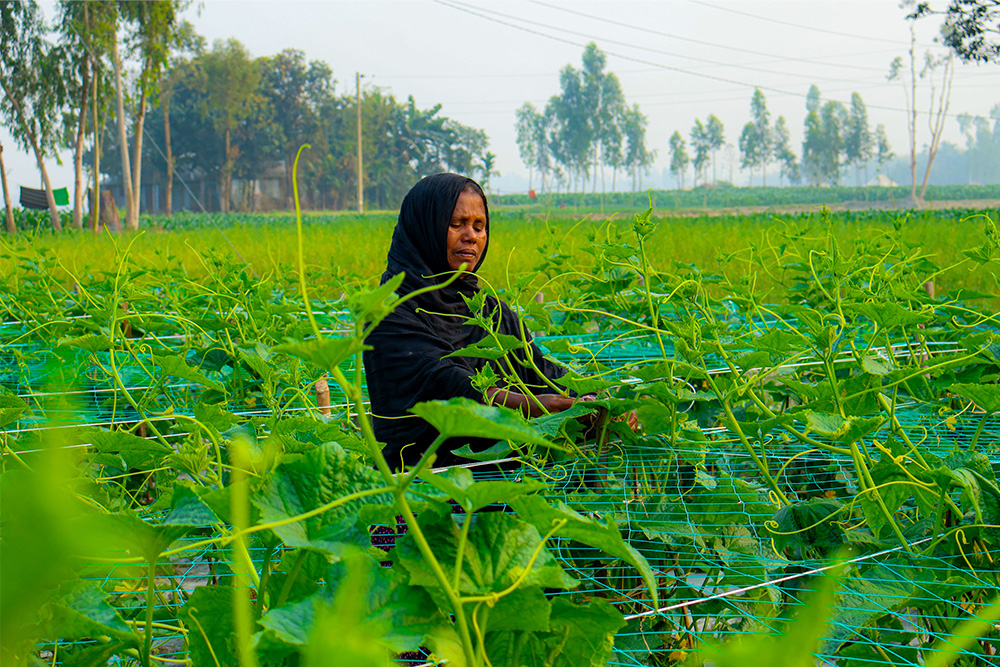
At home, the change is just as clear. Rupia’s income helps the family meet their basic needs and pays for her younger daughter’s education.
Growing vegetables has also opened a longer-term path. Rupia now plans to move beyond her small homestead garden and set up commercial vegetable farming on larger land.
The journey began with support, but the next steps are hers.
“I want to turn my small garden into a real farm, and I want my daughter to study as far as she wishes. The SEED project gave me the first step, and I will walk the rest of the way with my own hands.”
The Teesta once took her family’s land and livelihood. Today Rupia is building something new: an income she can grow, knowledge she can use and a future she is shaping herself.